
Inst. #5 from Dr. King’s Authentic Radicalism
Clinton proved the Rejection Defense is simple in 1992. Seth Moulton found it’s simple but not easy in 2024. (Catch up with the table of contents.)
Chapter 2
Social Pressure and Canceling
“If you’re a gang member and you would normally be killing somebody, why not kill a white person?” Bill Clinton did not see this as progressive. It was just Sister Souljah’s performative radicalism, the exact opposite of Dr. King’s authentic radicalism, and she had just staked out this position in a Washington Post interview.
It was 1992, and Clinton was making his first run for president. Souljah’s style of radicalism was still associated with Democrats and not Republicans, because Democrats were afraid to speak out against it and some even applauded it. Something needed to be said. Surprising everyone with his boldness, Clinton made the right choice. He used the Rejection Defense, exactly as described in the prologue. And it worked famously. It’s still known as his “Sister Souljah moment.” That was credited as one of the main reasons he could take back the White House after Republicans held it for 20 of 24 years, interrupted only by Jimmy Carter’s post-Watergate single term in office.
The Rejection Defense requires (1) rejecting the ideology, not the person, and (2) doing so conspicuously. Running for president makes the conspicuous part easy, but timing still matters. Clinton seems to have been waiting for the perfect opportunity to create the distance he and the Democrats needed from this outdated Black Power radicalism, and he got lucky.
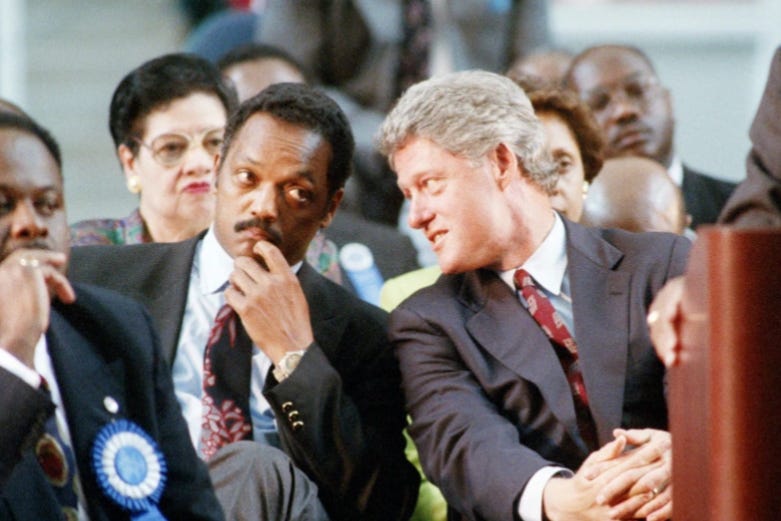
Clinton was speaking to Jesse Jackson’s social-justice activist group, the Rainbow Coalition. Jackson had just expressed pride in having Sister Souljah as a guest speaker the night before. The Washington Post, in response to a question about Black-on-white violence during the Rodney King riots had recently reported Sister Souljah’s response. Question: “Even the people themselves who were perpetrating that violence, did they think that was a wise reasoned action?”
Yeah, it was wise. If black people kill black people every day, why not have a week and kill white people? . . . So if you’re a gang member and you would normally be killing somebody, why not kill a white person?
Yes, why not have a week and kill white people? What a cool radical idea. Clinton condemned her violent ideology with Jackson sitting right there. This is exactly what “conspicuously reject” means. Clinton knew this would upset Jackson, who had claimed Martin Luther King’s mantle and was now disgracing it. His speech infuriated Jackson and many left-wing activists. Just as planned, this made headlines, and the incident has still not been forgotten.
As recently as September 2025, Marc Novicoff, writing for the Atlantic, used it to advocate for exactly what I’m calling the Rejection Defense. He quoted Elaine Kamarck — a Brookings fellow and one of the founders of the New Democrat movement that helped elect Clinton — “You’ve got to go against your party. … If nobody gets mad, you’re not doing anything courageous.” Conflict proves your independence, which is the whole point of the Rejection Defense.
Clinton showed he had the courage to stand up to the extremists. It worked. Clinton won back Reagan Democrats who rightly feared the party had moved into extremist territory. Clinton set back Jackson’s polarizing trend while reducing anti-Democratic polarization on the right.
The far left sees such moves as pandering to the right. No, it’s standing up for decency. Jackson and Souljah’s move signaled to white people that Black people thought having a week to shoot whites was a good idea. That’s an insult to Black people and it only serves to increase white racism. The Democrats do not need the help of “friends like these.” And we must find the strength within our party to speak out against such warped “progressive” ideology.
So the central question behind this book remains: Why has it proved impossible to adopt such a simple, morally imperative strategy, which we saw work more than three decades ago?
We now know that the Rejection Defense is completely feasible, that it works, and that it’s been endorsed and demonstrated by one of the Democratic Party’s most canny and down-to-earth politicians. So what’s stopping us? The two forces discussed in the introduction — deception and social pressure. The Anderson story addressed deception — the creation of dreadfully mistaken true believers.
Clinton was not deceived, and he overcame the social pressure so thoroughly that it’s hard to see. This shows it’s possible, but not why it’s difficult. So we need an example that shows the difficulty, and for some, the seeming impossibility of overcoming the social pressure.
The Price of Speaking Up
Just after the 2024 election, Representative Seth Moulton of Massachusetts told The New York Times, “I have two little girls, I don’t want them getting run over on a playing field by a male or formerly male athlete.” He meant a male who self-identifies as female, but may have gone through male puberty and not had surgery. Within weeks, Moulton’s view would poll 66% among Democrats.
Yet, in the following weeks, his campaign manager resigned, protesters swarmed his district office, and Salem’s Democratic Party chair referred to him in an email as a “Nazi cooperator.” She threatened to find a primary challenger, and she did.
Scores of colleagues approached him in the halls of Congress to say in a whisper, “Thank you for saying that, because I really can’t.” Moulton estimates that the majority of US Democratic Representatives are being silenced on this one issue. Surely, there are many more issues like this.
The Way Forward
Clinton proved the Rejection Defense is simple. The Moulton example proved that simple is not so easy. The Marlon Anderson story showed what makes it easier — having supporters who will stand by you instead of whispering their support when no one’s listening. That will take organizing, and I’ll discuss some possibilities toward the end of the book. Countering social pressure is essential. But remember there are still more sensible Democrats than extremists.
The Anderson story revealed the astounding power of far-left deception. That’s a clear and present danger that makes the case for the importance of stopping far-left ideology. But seeing the content of that deception helps make the Rejection Defense easier to apply. That’s because rejecting their ideology can feel like abandoning our allies — because that’s what they claim to be. As you’ll see in the next four chapters, they are not our allies at all. They are out for themselves.
The Anderson story makes this obvious. On purely moral grounds, we should feel good about opposing the far-left’s zero-tolerance n-word dogma. Those who take such an unforgiving and misguided view of the world need to do a lot more homework before they qualify as allies. As we look at far-left history, it will become clear that this was a very minor example of the immorality of their ideology.
But keep in mind that the Rejection Defense does not call for rejecting idealistic members of the far left, even if they promote truly terrible ideas. It simply calls for rejecting the harmful ideas themselves. This would be the right thing to do even if it did not help us win elections and fight polarization.
Have you ever taken a risk like Moulton did? Or been afraid to because you knew the risk? Also, one comment has already resulted in a clarification in the book itself — added paragraph #3 in the Prologue.