
Emergency Edition, Nov. 2026 — that’s now on the cover as I cut some corners to get the book out on time. And given DSA’s victories that has a double meaning. Today you will read about the American Communists infiltrating the FDR administration. On Nov. 3, you can watch DSA infiltrate the Democrats. That socialist organization has now been half infiltrated — by three varieties of Communists, no less.
Dr. King’s Authentic Radicalism
Chapter 3
Red Scares and Pink Puppets
The Second Red Scare is generally said to start in 1947; that’s when the Democrats woke up to the scare. Truman had been worried from the start of 1946 and invited Winston Churchill to give his “Iron Curtain” speech on March 6 in order to test his party’s readiness to admit the dangers of Stalinism. It did not go well. The Democrats, led by Henry Wallace, then Secretary of Commerce, and FDR’s third-term vice president, rallied around Stalin and rejected Churchill.
Truman kept his head down until after the party’s massive defeat in November and then immediately engaged the gears to produce his Loyalty Oath Program. That accounted for roughly half, and possibly more, of those who were dismissed or compelled to resign. Both the massive defeat and Truman’s immediate reaction indicate that the Red Scare was already politically powerful during the 1946 election, although the public had not yet seen any direct evidence of spying or policy damage.
The back story to the 1946−’48 phase of the Red Scare is stranger than fiction. From late 1934, early in the Roosevelt error, there were active communist spies in the Federal Government, particularly under Agricultural Secretary, Henry Wallace, who was fond of Soviet agricultural collectives — or at least, what he imagined them to be. By the end of 1945, Stalin had recruited over 500 active spies in the U.S., with at least 50 in the federal government.
Miraculously, by January 1946, all federal government spying by American communists, and all of the dangerous atomic spying had ended — but no one knew. So in April 1946, Carroll Reece took over the Republican National Committee and launched the Red Scare. He was right. All the communists who had been spying or just influencing policy were still in place.
Here’s what no one knew. Elizabeth Bentley, who had been managing the two largest federal spy rings, wrote a 108-page confession detailing her activities, walked into an FBI office on November 7, 1945, and handed it to them. (Later, decrypted cables from Soviet Embassies and access to Soviet historical documents after the fall of the Soviet Union proved she was truthful.)
The FBI promptly passed this information to the Chief British Security Coordinator in New York, who gave it to Kim Philby in M16, Britain’s foreign intelligence office. And on November 20, Philby informed Moscow. (Philby was one of the Cambridge Five — yes, Cambridge University, the unrecognized top WWII spy agency, so to speak.) Moscow realized all their federal government spies would now by closely watch, and to save them, shut down the whole operation.
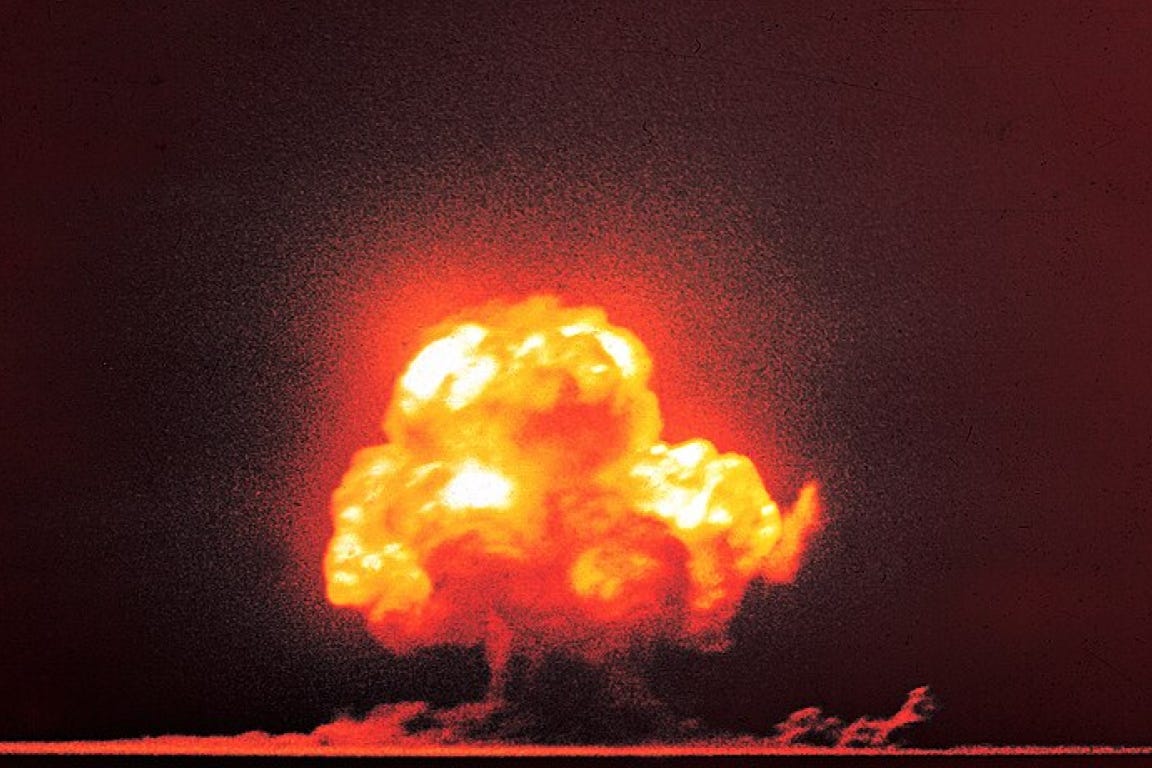
As to atomic spies at Los Alamos, Klaus Fuchs, a brilliant British (originally German) physicist, had already handed over, on September 19, 1945 the final details of the A-bomb you saw tested in the film “Oppenheimer.” The first Russian A-bomb was an exact copy in every detail. They had actually received two independent sets of plans from Los Alamos.
So by 1946, it was all over but the hysteria. Didn’t anyone know? Only the Russians. Even FBI Chief J. Edgar Hover didn’t know the Russians had shut down the federal spy network and didn’t know about the atomic spies. But hadn’t someone known about the decade of spying?
Whittaker Chambers, who first revealed hard evidence of federal spying in late 1948 had stopped working as a Soviet courier about a year before Stalin signed a non-aggression treaty with Hitler. Upset by that, 10 days later, in September 1939, he met with Assistant Secretary of State Adolf Berle, who took copious notes and gave Roosevelt a memo titled “Underground Espionage Agent.” Roosevelt just scoffed. He was sure the talk of spies was just a Republican scheme to damage his administration. Berle didn’t even pass his memo on to the FBI.
A few days after Elizabeth Bently informed the FBI, Hoover sent a memo indicating there was an extensive spy problem to Truman. He didn’t trust Hoover, and ignored the memo. So from late 1934 until late 1945 there were active spy networks, and no one but Bentley and a few FBI agents had any hard evidence until late 1948.
But the Republicans were suspicious, and rightly so. However they politicized their charges to such an extent that Democrats rejected them in knee-jerk fashion. The Republican slogans included, “pink puppets are in control of the federal bureaucracy,” and “Communists versus Republicans.”
In spite of all the misinformation, the standard radical setback dynamic applies. The root of the problem is far-left radicals. Most of them were deceived by communist and socialist propaganda, but that’s the usual story with radicals. Step two of the dynamic is the failure of non-radical Democrats to reject the left radicals, and instead cover up the radicalness of their views. As a result step three is inevitable — the Republicans tar the entire Democratic Party with radical beliefs that most don’t have. In 1946 they labeled the whole party as pink puppets or Communists.
Steps one and three are completely obvious, but it’s worth checking how step two played out.
On February 16, 1946, the front page of the NY Times announced, “Canada Seizes 22 as Spies—Atom Secrets Believed Aim.” Three days later, a former Roosevelt appointee reacted to this, saying the Russians had “every moral right” to seek atomic bomb secrets through military espionage. Truman’s Secretary of State refused to comment on this blatantly anti-American view. His silence associated the Democrats with the communists.
The next major problem for the Democrats was a House subcommittee appointed on May 2, 1946, to investigate “employee loyalty and employment policies.” This Democratically controlled subcommittee held hearings from June 3-10, 1946, and issued its report on July 20. The report concluded that existing security procedures were inadequate and “American security was threatened” by disloyal federal employees and recommended creating a comprehensive loyalty investigation system. In fact, existing security procedures were essentially nonexistent.
After saying “American security was threatened,” the Democrats did exactly nothing. Again, this looks like Democrats protecting the extreme left and their own words were easy to use against them.
Next up was Henry Wallace, Roosevelt’s third-term vice president, who had hired most of those who formed the Ware Group, the first communist inside the Roosevelt administration. He was outraged by Truman’s anti-Stalin position, as exemplified in Wallace’s famous speech in Madison Square Garden, “Under friendly peaceful competition, the Russian world and the American world will gradually become more alike.” Wallace was Secretary of Commerce at the time, and was interfering with Truman’s foreign policy. That was a helpful move on Truman’s part, but overall, this just illustrated the enormous difficulty the Democrats were having keeping their distance from the radical left.
Come November, the Democrats dropped 12 senators and 55 representatives, losing both houses of Congress, the first time they’d lost either in 34 years. Associating with far-left ideas cost them dearly. Because they had not used the Rejection Defense, they were forced into a harsh policy to save their party.
The problem of disloyalty had long been clear from the CPUSA’s membership oaths, such as “I pledge [to support] the Leninist line … that insures (sic) the triumph of Soviet Power in the United States.” Something very close to that was signed, and usually sworn to as well, by something like 200,000 (taking account of turnover).
Few of these good Americans knew of Stalin’s role in the millions of Ukrainians who died of famine or the million loyal socialists worked to death in his Siberian slave labor camps. This made it much easier to adopt a pro-Stalin anti-American ideology. It’s now time to meet Alger Hiss, the prototype of the anti-American performative radical.
Yes, the Red Scare began as a perfectly justifiable attempt to go after Soviet spies. Then they stretched it to include anyone who belonged to the same political party as Soviet spies. Then they stretched it to include anyone who used to belong to the same political party as Soviet spies twenty years earlier. Then they stretched it to include anyone who'd served on the same committee or signed the same petition or appeared on the same stage as anyone who used to belong to the same political party as Soviet spies twenty years earlier. Then they stretched it to include anyone who didn't show sufficient zeal going after anyone who'd served on the same committee or signed the same petition or appeared on the same stage as anyone who used to belong to the same political party as Soviet spies twenty years earlier. Step by step, each a defensible-seeming escalation of what had come before, we ended up with something so crazy that--you know how sometimes you remember a seemingly small detail because it says so much--a three year old girl working as a model was denied a paycheck because she couldn't sign a loyalty oath.