
I promised you book installments twice a week. What happened? I’ve got plenty lined up, but they need to be read in order. And I suddenly realized something big was missing right between #2 and #3. Quite possibly the most important part of the book. It will come to you in 4 parts, this is the first. They’re all written and edited. I’m hoping for no more delays.
Democrats have been hammered five times in a hundred years — not by the extreme left, but by the backlash they cause. Listening to my radical radio station in the ‘60s and ‘70s, I heard how they were always innocent. What they were actually up to is my untold story (until now). Yes the backlash was nasty, but why should the Democrats suffer that for left-wing crimes?
There’s plenty of action, but few intentional villains — just dedicated, idealistic people sucked in by the likes of Stalin. The cost of idealism, can be 11 years in the Gulag, but in the end she saved my favorite far-left anti-hero and lived happily ever after. (Catch up)
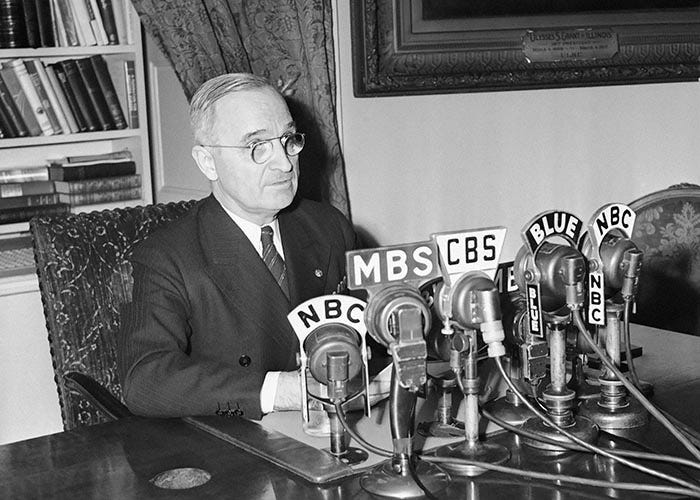
Part 1. With Friends Like These
Introduction
Franklin and Eleanor Roosevelt had just walked past Attorney General Palmer’s house at 11 p.m. on June 2, 1919. Crossing the street to their own home, they’d hung up their coats and walked to the back of their home when chunks of Carlo Valdinoci landed on their front porch. His bomb, containing over 25 pounds of dynamite and a load of shrapnel, had detonated a bit early as he was delivering it to the front door of the Palmers’ home.
And what could this possibly have to do with Trump’s presidency?
The anarchist bombings, followed quickly by two communist parties declaring their allegiance to Vladimir Lenin, led to the Palmer raids that resembled Trump’s ICE operations. But what matters is the apparently inescapable pattern. Fortunately it only looks inescapable, because we have not learned to recognize it and prevent it. We’re now experiencing the fifth episode in 100 years, and on the surface they all look quite different.
This introduction examines these five “radical setbacks” and shows how to diagnose this ailment. Much of the problem is caused by how it mutates and changes its appearance before each new outbreak, even while maintaining its essential features. To avoid confusion, it’s best to know the diagnostic symptoms in advance:
Harming: Associating with far-left ideas harms the Democrats.
Silencing: Social pressure and deception blind us to the need for the Rejection Defense to break our association with far-left ideology.
The prologue introduced the example of Kamala Harris being harmed by far-left ideas and argued that the Rejection Defense — conspicuously rejecting far-left extremism — was needed. But it did not establish that such harm is part of a long-term pattern that’s unlikely to stop on its own. Establishing this is the job of Part 1.
This introduction focuses on the harm done by this persistent pattern and provides insights into the social pressure and deceptions that blind us to it. The chapters of Part 1 explain the power and continuity of the ideology behind this pattern.
Symptom 2 — silencing — is the harder of the two to see, precisely because it’s working on us right now. Here is a recent example. In April 2025, Yale invited a prominent radical to give two sold-out lectures in perhaps the most prestigious international lecture series on ethics and moral philosophy. The publicity materials said nothing about the fact that the invitee had provided the shotgun that was taped to a judge’s neck before it blew his brains out. Left-wing social pressure made this unmentionable, leaving us without the understanding we need to see and fight this harmful pattern.
The antidote, as illustrated dramatically in what follows, is crucial facts from trusted sources. My hope is that this book, full of such facts, can earn your trust. To understand how we got here, start in 1919.
The First Red Scare
The First Red Scare was kicked off by the simultaneous bombing of the homes of seven prominent Americans and a Catholic Church. A month later, Palmer created the Radical Division of the FBI, and appointed J. Edgar Hoover to head it. Hoover served as head of the FBI through its surveillance and harassment of Martin Luther King, and then the Black Panthers.
For seventy years, Marxism had seemed merely a fever dream of the far-left, but then in 1917 Lenin seized power in Russia. A month after Hoover’s appointment, two thirds of the Socialist Party of America split off to form two rival communist parties, both loyal to Vladimir Lenin. That’s why Hoover’s main target was communists, but Palmer even went after conservative unions. The setback for unionism was long lasting, and between 1916 and 1920, the Democrats went from winning by 3% to losing by 26%. The country stayed conservative until the Great Depression handed FDR a landslide in 1932. That ended the first of the five radical setbacks.
Without far-left ideology, there would have been no Red Scare.
Soon after this Red Scare, Lenin forced the two communist parties to merge into the CPUSA—the foundation for the second radical setback.
Democrats Forced to Hunt Communists
By the end of 1945, Stalin had recruited over 500 active spies in the U.S., with at least 50 in the federal government. On February 16, 1946, the front page of the NY Times announced, “Canada Seizes 22 as Spies—Atom Secrets Believed Aim.” Three days later, a former Roosevelt appointee reacted to this, saying the Russians had “every moral right” to seek atomic bomb secrets through military espionage. Truman’s Secretary of State refused to comment on this blatantly anti-American view. His silence associated the Democrats with the communists.
Henry Wallace (Roosevelt’s third-term vice president), was outraged by Truman’s anti-Stalin position, as exemplified in his famous speech in Madison Square Garden, “Under friendly peaceful competition the Russian world and the American world will gradually become more alike,” Wallace was so popular among Democrats that Truman was unable to address loyalty until after the election.
The Republicans took advantage of naive Democrats backing radical CPUSA positions and launched their anti-Communist campaign, charging, “pink puppets are in control of the federal bureaucracy.” Come November, the Democrats dropped 12 senators and 55 representatives, losing both houses of Congress, the first time they’d lost either in 34 years. Associating with far-left ideas cost them dearly.
Democrats had rejected a loyalty oath program recommended by a Democratically-controlled House committee early in the campaign. But the magnitude of the electoral loss both freed and forced Truman’s hand, and he set such a program in motion less than a month after the traumatic loss. As the Washington Post reported as recently as February 2025, loyalty was determined by such questions as “‘Do you go to church?’ and ‘Did you and your wife live together before you were married?’” This was not a targeted program. The government generated loyalty forms for more than 4.7 million current and aspiring federal employees. Once again, a severe electoral setback accompanied by human hardship would not have happened had the radicals — the CPUSA in this case — not been up to their ideologically driven schemes.
Because they had not used the Rejection Defense, they were forced into a harsh policy to save their party.
The problem of disloyalty had long been clear from the CPUSA’s membership oaths such as “I pledge [to support] the Leninist line … that insures (sic) the triumph of Soviet Power in the United States.” Something very close to that was signed, and usually sworn to as well, by something like 200,000 (taking account of turnover). Few of these good Americans knew of Stalin’s role in the millions of Ukrainians who died of famine or the million loyal socialists worked to death in his Siberian slave labor camps.